
DENTAL IMPLANTS
What are they?
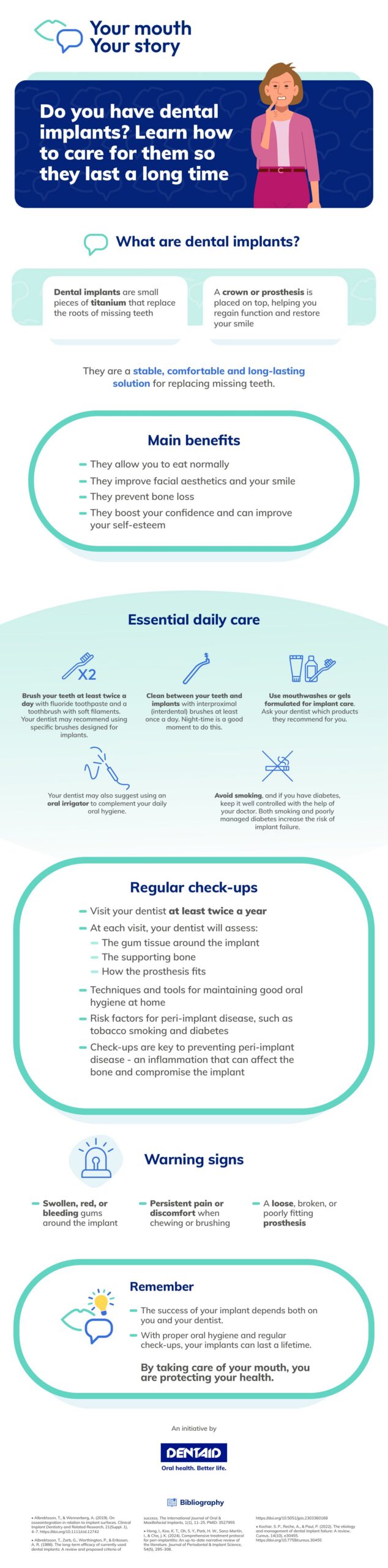
Dental implants are small components made of titanium or other biocompatible materials that are placed in the upper or lower jaw to replace the roots of missing teeth.
A crown, bridge, or prosthesis is then attached to the implant, restoring both function and aesthetics.
Today, implants are among the most advanced solutions for tooth loss, or edentulism, offering natural-looking and long-lasting results.
Why are they placed?
Implants are recommended when one or more teeth are missing and a fixed, comfortable, and stable solution is desired. Their benefits include:
- Improving chewing ability, so you can enjoy all types of food.
- Restoring your smile and facial appearance.
- Preventing bone loss that can occur after tooth loss.
- Boosting confidence and self-esteem, while avoiding the inconvenience of removable dentures.
Who might need implants?
Candidates include anyone who:
- Has lost one, several, or all teeth.
- Has enough healthy bone in the jaw.
- Is looking for a stable alternative to removable dentures.
Implants are not always suitable: people with conditions such as uncontrolled diabetes, blood clotting problems, severe osteoporosis, or habits like excessive smoking may hinder the success of the treatment.
What does the procedure involve?
Before surgery
- Comprehensive examination: The dentist will review your medical history, habits, and medications, perform a clinical examination, and take x-rays or a scan to assess your bone and gums.
- Personalised planning: The number, type and position of the implants are determined according to the prosthesis to be fitted.
During surgery
- The implant is placed into the bone under anaesthesia.
- In some cases, the prosthesis (artificial tooth) can be placed immediately, although it is usually necessary to wait for the gum to heal.
After surgery
- Initial care: Follow a soft, warm diet, avoid smoking and alcohol, maintain good oral hygiene, and take medication prescribed.
- Healing: This usually takes between 3 and 6 months, the time needed for the implant to integrate with the bone (osseointegration).
Long-Term Maintenance
- Brush your teeth gently at least twice a day with toothpaste and clean between your teeth and implants with interproximal (interdental) brushes at least once a day.
- Your dentist may recommend specific mouthwashes or gels, as well as the use of an oral irrigator.
- If you wear a removable denture, it is recommended that you clean it at least once a day with soap and a brush designed for dentures, and to remove and store it in a dry place overnight.
- More frequent check-ups than with natural teeth are required to monitor gums, bone, and implant stability.
- Avoid smoking, as it significantly increases the risk of implant failure.
What risks or complications can arise?
Although implants have a high success rate, issues such as the following may occur:
- Poor healing
- Peri-implant disease: inflammation of the mucosa and bone around the implant, similar to periodontal disease (gum disease) but more aggressive
- Pain or discomfort
- Fracture of the prosthesis
Most of these problems can be prevented or treated if detected early during routine check-ups.
Practical Tips
- Maintain excellent oral hygiene: brush at least twice a day and clean between your teeth at least once. For complete oral hygiene, you can also include mouthwash and oral irrigators in your routine. Remember, implants require more thorough care than natural teeth.
- Attend all the check-ups scheduled by your dentist (at least twice a year).
- Avoid tobacco, limit alcohol consumption, and keep any health conditions, such as diabetes, under control.
If you notice pain, inflammation, or bleeding around the implant, see your dentist. Remember, implants can be affected by disease more aggressively than natural teeth.
When should you see a dentist?
Consult a professional if:
- The mucosa around the implant is inflamed or bleeding.
- You experience persistent pain or discomfort in the implant area.
- The prosthesis on the implant doesn’t fit properly or has broken.
- You have difficulty chewing.

Remember
The success of your implant depends both on you and your dentist. With proper oral hygiene and regular check-ups, your implants can last a lifetime.
Take care of your mouth, protect your smile.
Access tailored solutions

Access tailored solutions
Bibliography
- Albrektsson, T., & Wennerberg, A. (2019). On osseointegration in relation to implant surfaces. Clinical Implant Dentistry and Related Research, 21(Suppl. 1), 4–7.
- Albrektsson, T., Zarb, G., Worthington, P., & Eriksson, A. R. (1986). The long-term efficacy of currently used dental implants: A review and proposed criteria of success. The International Journal of Oral & Maxillofacial Implants, 1(1), 11–25. PMID: 3527955
- Hong, I., Koo, K. T., Oh, S. Y., Park, H. W., Sanz-Martín, I., & Cha, J. K. (2024). Comprehensive treatment protocol for peri-implantitis: An up-to-date narrative review of the literature. Journal of Periodontal & Implant Science, 54(5), 295–308.
- Kochar, S. P., Reche, A., & Paul, P. (2022). The etiology and management of dental implant failure: A review. Cureus, 14(10), e30455.
- Kupka, J. R., König, J., Al-Nawas, B., Sagheb, K., & Schiegnitz, E. (2024). How far can we go? A 20-year meta-analysis of dental implant survival rates. Clinical Oral Investigations, 28(10), 541.