
Tooth Loss

What is edentulism?
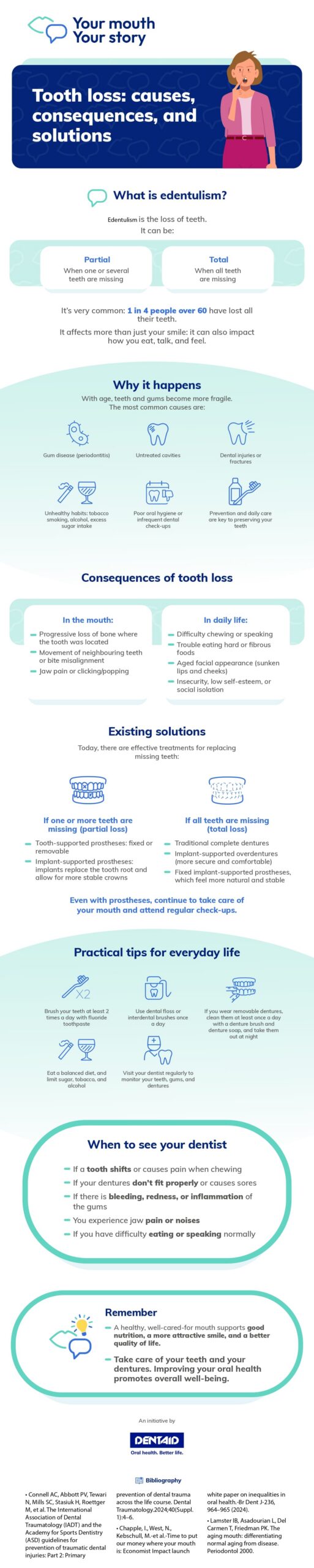
Edentulism is the loss of teeth. It can be:
- Partial, when one or several teeth are missing.
- Total, when all teeth are missing.
It is a common issue: about 1 in 4 people over 60 experience total tooth loss. Losing teeth affects more than just your smile; it can also impact eating, speaking, and how you feel about yourself.
Why does it happen?
As we age, our teeth and gums can weaken. The most common causes include:
- Gum disease (periodontitis or pyorrhea), which can loosen teeth and eventually lead to tooth loss.
- Untreated cavities, which can progress and destroy the tooth.
- Dental trauma or fractures.
- Unhealthy habits, such as smoking, drinking alcohol, or high sugar intake.
- Lack of regular dental check-ups and insufficient oral hygiene.
What are the consequences?
In the mouth:
- Gradual bone loss in the area where the tooth was.
- Neighbouring teeth may shift, causing bite misalignment.
- Jaw pain or noises when opening or closing the mouth.
In daily life:
- Difficulty chewing properly and pronouncing certain words.
- Challenges eating hard or fibrous foods.
- Changes in facial appearance, such as sunken lips and cheeks.
- Lower self-esteem, insecurity, and a higher risk of social isolation
How can it be treated?
Partial tooth loss
(one or more teeth missing):
- Tooth-supported prostheses: can be fixed or removable
- Implant-supported prostheses: dental implants replace missing teeth and provide a stable foundation for crowns or bridges
Total tooth loss
(all teeth missing):
- Traditional complete dentures
- Removable implant-supported dentures (overdentures).
- Fixed implant-supported prostheses: offer a more natural feel and greater stability.
Practical tips for everyday life
Brush your teeth at least twice a day with fluoride toothpaste
Use dental floss or interdental brushes at least once a day.
If you wear removable dentures, clean them at least once a day with a denture brush and denture soap, and take them out at night.
Maintain a varied and balanced diet, and limit sugar, tobacco, and alcohol.
Visit your dentist regularly to check your teeth, gums, and dentures.
When should you see a dentist?
Consult a professional if:
- A tooth feels loose or causes pain when chewing.
- Your dentures no longer fit properly or cause irritation.
- You notice bleeding, inflammation, or other changes in your gums.
- You experience jaw pain or noises.
- Tooth loss is making it difficult to eat or speak.


Remember
A healthy, well-cared-for mouth supports good nutrition, a more attractive smile, and — most importantly — a better quality of life.
Access tailored solutions

Access tailored solutions
Bibliography
- Connell AC, Abbott PV, Tewari N,Mills SC, Stasiuk H, Roettger M, et al. The International Association of Dental Traumatology (IADT) and the Academy for Sports Dentistry (ASD) guidelines for prevention of traumatic dental injuries: Part 2: Primary prevention of dental trauma across the life course. Dental Traumatology.2024;40(Suppl. 1):4–6.
- Chapple, I., West, N., Kebschull, M. et al. Time to put our money where your mouth is: Economist Impact launch white paper on inequalities in oral health. Br Dent J 236, 964–965 (2024).
- Lamster IB, Asadourian L, Del Carmen T, Friedman PK. The aging mouth: differentiating normal aging from disease. Periodontol 2000. 2016;72(1):96–107.
- Herrera, D., Sanz, M., Shapira, L., Brotons, C., Chapple, I., Frese, T., Graziani, F., Hobbs, F.D.R., Huck, O., Hummers, E., Jepsen, S., Kravtchenko, O., Madianos, P., Molina, A., Ungan, M., Vilaseca, J., Windak, A. & Vinker, S. (2023). Association between periodontal diseases and cardiovascular diseases, diabetes and respiratory diseases: Consensus report of the Joint Workshop by the European Federation of Periodontology (EFP) and the European arm of the World Organization of Family Doctors (WONCA Europe). Journal of Clinical Periodontology, 50(6), 819–841
- Khanagar SB et al. Age-related Oral Changes and Their Impact on Oral Health-related Quality of Life among Frail Elderly Population: A Review. J Contemp Dent Pract. 2020;21(11):1298-1303.
- Pina G.D.M.S., Carvalho R.M., Silva B.S.D.F., Almeida F.T. Prevalence of hyposalivation in older people: A systematic review and meta-analysis. Gerodontology. 2020;37:317–331.
- Sälzer S.et al. Contemporary practices for mechanical oral hygiene to prevent periodontal disease. Periodontology 2000. 2020;84:35–44
- Stöhr J, Barbaresko J, Neuenschwander M, Schlesinger S. Bidirectional association between periodontal disease and diabetes mellitus: a systematic review and meta-analysis of cohort studies. Sci Rep. 2021 Jul 1;11(1):13686.
- Tonetti MS, Jepsen S, Jin L, Otomo-Corgel J. Impact of the global burden of periodontal diseases on health, nutrition and wellbeing of mankind: a call for global action. J Clin Periodontol. (2017) 44(5):456–62.