
Module 8
Oral Health Overview

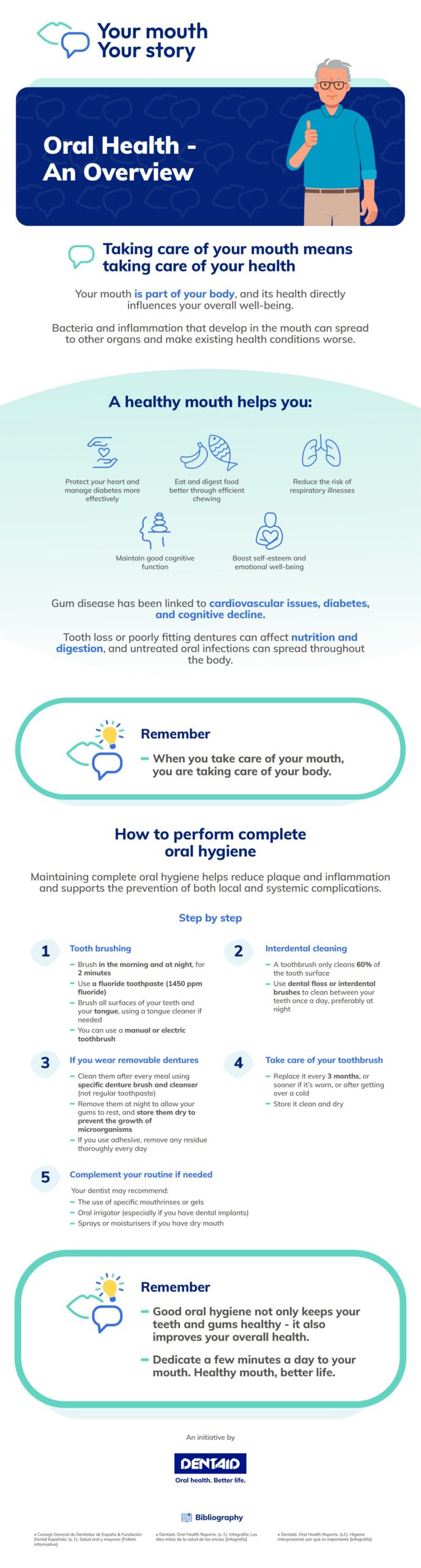
Taking care of your mouth means taking care of your health.
Taking care of your mouth means taking care of your health.
Your mouth is part of your body, and its health directly affects your overall well-being.
Bacteria and inflammation that originate in the mouth can spread to other organs and aggravate existing diseases. According to the World Health Organization, oral health is an essential component of overall health and psychosocial well-being. Taking care of your mouth is not just a matter of aesthetics, but a way to stay healthier, more active, and enjoy a better quality of life.
How does the mouth influence the health of the body?
- Gum disease (periodontal disease) is linked to cardiovascular disease, diabetes, chronic obstructive pulmonary disease, and cognitive decline.
- Tooth loss or ill-fitting dentures can make chewing difficult and lead to poorer nutrition and digestion.
- Untreated oral infections can spread to other parts of the body.
- Stress and anxiety also affect gum health, increasing the risk of inflammation.

A healthy mouth helps you:
- Take care of your heart and better control diabetes
- Eat and digest better
- Prevent respiratory conditions
- Maintain good cognitive health
- Improve self-esteem and emotional well-being
The importance of maintaining thorough oral hygiene
Brushing
- Brush all sides of your teeth at least twice a day (morning and night) for 2 minutes.
- Use fluoride toothpaste (1450 ppm fluoride).
- You can use a manual or electric toothbrush.
- Don’t forget to clean your tongue from the back to the front. You can find tongue cleaners for this purpose at pharmacies.
Interdental cleaning
- Remember that regular brushing only cleans 60% of the surfaces of your teeth; the remaining 40% is achieved through interdental cleaning.
- Clean between your teeth once a day, preferably at night.
- Use dental floss or interdental brushes, as recommended by your dentist.
If you have removable dentures:
- Remove and clean your dentures after every meal with a special brush reserved solely for this purpose.
- Clean and care for your removable dentures with specific denture products such as cleaning tabletsNever use conventional toothpaste: it can damage the dentures.
- If you use denture adhesive, remember to remove any residue at the end of the day from both your mucosa and dentures.
- Store your dentures in a dry container overnight.
Brush care:
- Replace it every 3 months or sooner if the bristles are deformed or you have had the flu.
- Keep it dry and clean.

Your dentist may recommend the use of supplements such as:
- Mouthwash.
- Oral gel.
- Oral spray.
- Oral irrigator, especially if you have implants.

Remember
Visit the dentist at least once a year (or more often depending on your situation). Checkups allow problems to be detected early and your dentures or implants to be adjusted if necessary.
Maintaining good oral hygiene reduces bacterial load and inflammation in the body, helping to prevent general health complications.
Access tailored solutions

Access tailored solutions
Bibliografía
- Cannon, B., et al. (2023). Polypharmacy and xerostomia in older adults: a systematic review. Journal of the American Geriatrics Society, 71(1), 123–135.
- Han, P., et al. (2015). Dry mouth: a critical topic for older adult patients. Journal of Prosthodontic Research, 59(1), 6–19.
- Hayslett, R. L., & Marshall, T. A. (2025). Clinical evaluation of xerostomia. Dental Clinics of North America, 69(2), 123–139.
- López-Pintor, R. M., et al. (2016). Xerostomia and salivary gland hypofunction in systemic diseases. Medicina Oral, Patología Oral y Cirugía Bucal, 21(3), e250–e255.
- Niklander, S., et al. (2017). Oral manifestations in systemic conditions. Medicina Oral, Patología Oral y Cirugía Bucal, 22(5), e554–e561.
- Pai, S., et al. (2001). Development of a visual analog scale for subjective assessment of xerostomia. Oral Surgery, Oral Medicine, Oral Pathology, 91(3), 311–316.
- Pedersen, A. M. L., et al. (2018). Salivary secretion in health and disease. Journal of Oral Rehabilitation, 45(9), 730–746.
- Pina, G. S., et al. (2020). Prevalence of xerostomia in older adults: a systematic review. Gerodontology, 37(4), 317–327.
- van der Putten, G. J., et al. (2011). Xerostomia and medication use in the elderly. Clinical Oral Investigations, 15(2), 185–192.
- Villa, A., Connell, C. L., & Abati, S. (2015). Diagnosis and management of xerostomia and hyposalivation. Therapeutics and Clinical Risk Management, 11, 45–51.